

Sicily History Trail: Greek Temples to Norman Gold
Destination guides · Sicily
Sicily travel reveals a living museum of Mediterranean history, shaped by past civilisations. From the colossal Greek temples of Agrigento to golden Norman mosaics, Sicily captivates visitors. Overall, the island offers an unparalleled journey through time and layers of Mediterranean culture.
A small ship cruise is the perfect way to explore Sicily travel highlights from coast to coast. In fact, it offers access to historic ports, UNESCO sites, and stunning coastal towns, without the crowds.
This voyage visits ancient Greek city-states, Norman palaces, and timeless Sicilian landscapes. Also, it reveals how history and culture are deeply woven into Sicily’s identity.
In short
Sicily history runs from the Greek colonies of Magna Graecia to the Norman kingdom of Roger II. For the Greek story, see the Valley of the Temples at Agrigento, Taormina’s Greek theatre and Syracuse. For the Norman golden age, see the mosaics of the Palatine Chapel in Palermo and the cathedrals of Monreale and Cefalù. Our La Dolce Vita small ship cruise calls at Taormina, Catania and Syracuse.
2,500+
years old: Agrigento’s Doric temples
1132
Palatine Chapel commissioned by Roger II
6,500 m²
of gold mosaics in Monreale Cathedral
£2,913
from, 8-day La Dolce Vita cruise only
Greek Sicily
Sicily History Begins: Greek Sicily and the Dawn of Civilisation
Long before Rome dominated the Mediterranean, Sicily was the jewel of Magna Graecia (Greater Greece). Specifically, Greek settlers arrived in the 8th century BCE, transforming the island into a cultural and philosophical powerhouse.
Consequently, Syracuse, Agrigento, and Taormina became cultural hubs of politics, science, and art. They left behind architectural wonders that still stand today and help define the essence of Sicily travel.
Greek sites
Key Sites to Explore Sicily’s Greek Past
1. The Valley of the Temples, Agrigento
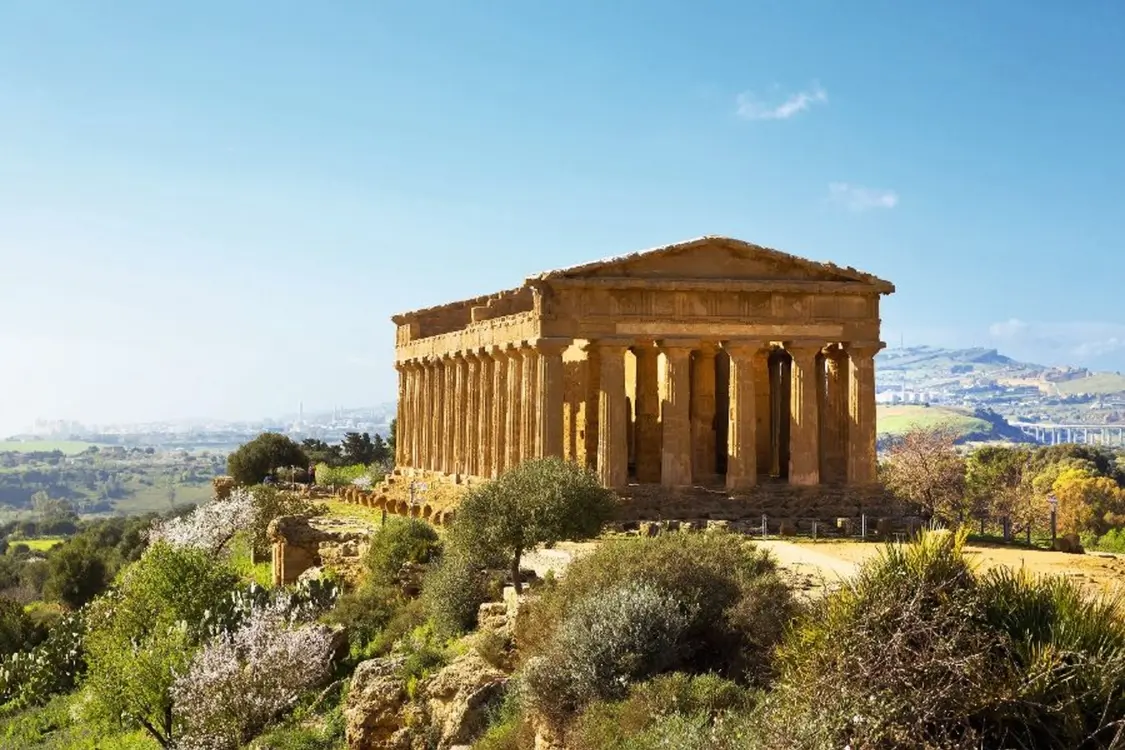
The Valley of the Temples is one of the world’s greatest archaeological parks. It showcases massive Doric temples built over 2,500 years ago. The Temple of Concordia, remarkably well-preserved, stands as a testament to the Greek mastery of architecture.
These destinations form the foundation of any meaningful Sicily travel experience focused on classical history.
- Best experience: Visit at sunset, when the golden light makes the ancient columns glow.
- Travel tip: Don’t miss the Kolymbethra Garden, a former irrigation basin turned citrus grove contrasting beautifully with the ancient ruins.
2. The Greek Theatre of Taormina
Perched above the Ionian Sea, this amphitheatre was built in the 3rd century BCE and later expanded by Romans. Notably, its breath-taking panoramic views of Mount Etna and the coastline make it one of Sicily’s most visited landmarks.
- Why visit? It still hosts live performances today, continuing a tradition dating back to the time of Euripides and Sophocles. Indeed, it is a rare gem in Sicily travel.
- Fun fact: The theatre was designed with perfect acoustics. Even today, whispers on stage reach the back rows.

3. Syracuse & The Ear of Dionysius
Once one of the most powerful Greek city-states, Syracuse played a key role in Mediterranean history. Its Greek Theatre, one of the largest in the ancient world, was the stage for legendary plays.
Nearby lies the Ear of Dionysius, a towering limestone cave. Legend says Dionysius used it to eavesdrop on his prisoners.
- Best experience: Whisper inside the cave and hear your voice echo back with surprising clarity.
- Hidden gem: Just a short walk away is the Altar of Hieron II. This ancient site hosted massive public ceremonies.

Norman Sicily
Norman Sicily Travel: A New Golden Age
Sicily’s transformation didn’t end with the Greeks. Besides, the Normans arrived in the 11th century. They brought an architectural style blending Latin, Byzantine, and Islamic influences.
Moreover, under rulers like Roger II and William II, Sicily flourished as a medieval kingdom. It became renowned for mosaics, cathedrals, and a rich multicultural legacy central to Sicily travel.
Norman sites
Key Travel Sites to Explore Sicily’s Norman Heritage
4. The Palatine Chapel, Palermo
Built inside the Norman Palace, this royal chapel is an artistic marvel. In particular, it features golden mosaics, Arabic-style ceilings, and Latin architectural elements. Commissioned by King Roger II in 1132, it symbolises the fusion of civilisations that made Sicily unique.
- What makes it special? Every surface is adorned with intricate artwork, creating an immersive experience that reflects the diverse cultures of medieval Sicily.
- Travel tip: Arrive early in the morning to avoid the crowds—this chapel is one of Palermo’s busiest sites!
5. The Cathedral of Monreale
The Monreale Cathedral, built in 1174, is one of the most awe-inspiring Norman cathedrals in the world. Notably, its 6,500 square metres of gold mosaics depict biblical scenes with breathtaking precision, created by Byzantine craftsmen.
- Why visit? It’s a masterpiece of medieval Europe, blending Norman, Arab, and Byzantine styles into a single architectural triumph.
- Hidden detail: Look for the mosaic of Noah’s Ark—it features charming animal pairs in vibrant colours.
6. The Cathedral of Cefalù
Overlooking the quaint coastal town of Cefalù, this fortress-like cathedral was built by King Roger II. In fact, it was erected as a symbol of Norman power. Inside, the Christ Pantocrator mosaic dominates the apse, one of the finest Byzantine artworks in Sicily.
- Best experience: Climb the bell tower for stunning views over Cefalù’s medieval rooftops and the Tyrrhenian Sea.
- Fun fact: Legend says Roger II built this cathedral after surviving a storm at sea, vowing to construct a church on the first land he reached.

Palermo, Monreale and Cefalù are on Sicily’s north coast. Our current Sicily cruises call at Taormina, Catania and Syracuse, and at Messina, rather than Palermo.
By small ship
Why a Small Ship Cruise Is the Top Sicily Travel Secret
Indeed, why choose a small ship? It’s the most sensible way to experience Sicily travel without the stress or the crowds:
- Access to historic ports: Dock directly in Syracuse and Taormina avoiding the congestion of larger cruise terminals.
- Intimate historical tours: Expert guides bring UNESCO sites and hidden gems to life with detailed storytelling.
- Unforgettable coastal views: Sail past Mount Etna, the Aeolian Islands, and the cliffs of Taormina, just as the ancients once did.
So, if you’re a traveller seeking an immersive experience, Seafarer Cruises has got you covered. The following curated small ship itineraries are designed to elevate your Sicily travel experience:
La Dolce Vita – Naples to Malta
Eight days on Variety Voyager, calling at Lipari, Taormina, Catania and Syracuse on the way to Malta. Sails July 2027.
Sicily & the Amalfi Coast by tall ship
Lipari and Stromboli, Messina, Amalfi and Sorrento under sail, April to September.
In conclusion, Sicily travel offers a rare chance to walk in ancient civilisations’ footsteps. From Greek philosophers to Norman kings, every corner of the island holds a story. From grand temples to golden mosaics, every stop tells a story.
Plus, with a small ship cruise, you can explore these iconic sites with ease, depth, and authenticity. If you’re seeking a historical escape rich in culture and beauty, Sicily travel is your perfect match. Get your personalised quote here.
Ready to explore Sicily?
See Sicily’s history by small ship
Ask us about our Sicily cruises, or call our team for a personalised quote.
Call or email us
Monday to Friday 09:00 to 19:00 · Saturday 09:30 to 17:00



Book with confidence. Seafarer, a family company, has specialised in small ship cruising since 1995, and every payment you make to us is financially protected: ATOL licence 9511 for holidays with flights, ABTOT member 5660 for holidays without.